Why Is the Power Off on Santiago Peak Again
How engine loading and propellers interact with vessel performance
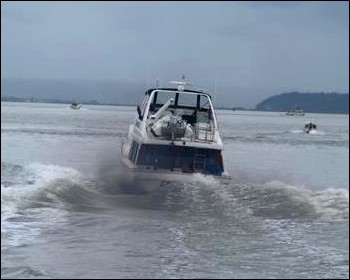
When troubleshooting a LOW Power symptom, or a low RPM issue on any high operation marine diesel that uses mechanical fuel injection (pregnant NO Electronics, or a true diesel that can run WITHOUT electricity), this is how we go most it (applies in 99 % of the depression power / low RPM issues that I accept seen). Although much of the same principles employ to the well-nigh modern electronic engines, because of the very sophisticated electronic control of the engines' fuel system, sometimes you need more than a visual of the exhaust output to guide you lot and become you lot started in the right direction.
Hopefully, these few paragraphs may save yous going thru an expensive and time consuming learning curve, rather than post-obit many of the old wives' tales & typical "dock talk" floating around in this industry that typically always leads you downwards the wrong road and becomes very costly without fifty-fifty finding the problem.
This is where nosotros starting time (a VISUAL of the frazzle leaving the vessel, nether your normal operating conditions): If you are seeing any dark or black fume during some or all of the operational RPM range, you most likely ARE NOT experiencing a fuel restriction trouble. I am going to stress that again. This IS Non a fuel supply or restriction result (chock-full fuel filters). You are either overloaded during some or all of the engine operational range, or you are not getting enough air (this can be from i or multiple reasons). Also sympathise that on many planing hulls, during the acceleration mode from 9-15K or and so (getting over the "HUMP"), some, to more than "some", black smoke could be perfectly normal as the engine pulls close to its maximum torque during the 10-60+ seconds it may take to become the vessel upwards on acme. This would be dependent on the vessels planing characteristics vs its weight and the HP available.
If you are not getting RPM (of course you've already verified that your tachometer accurate, is right?), or the past speeds yous used to have, and you have NO night/black smoke, then, you lot are not getting enough fuel your throttle linkage is not making full mechanical throttle, or your fuel solenoid linkage is not reaching the full mechanical stop or settings. These iii items cover most all complaints when you Practice NOT have night or black smoke to break this down to the next level:
Low POWER / LOW RPM AND YOU Have Dark SMOKE:
Propping issues: You are OVER PROPPED (overloaded or nether powered in the vessel's current configuration – call it what y'all like). Regardless of why, being overloaded is directly related to the propeller matching the vessels electric current running configuration, weight, vessel bottom status, windage, or running gear issues/weather condition, but all of these get dorsum to the prop as they all brand the engine work harder because of these conditions, and slow the vessel downward overloading the engine. Too, remember the term "external to the engine" as you read further.
AIR bug: Not getting enough air tin exist caused by a dirty/complanate air cleaner, a leaking turbo hose, a filthy aftercooler or air brake inside the aftercooler, a worn out or partially stuck turbo, or a poorly ventilated engine room. Any combo of these can restrict air to the engine causing night smoke and further, depression power.
Mayhap it's only one of your engines (similar it's trying to bear all of the load or won't grab up with the other one ?? Information technology doesn't thing, if you have dark fume, it'southward because of one or both of the above.
Depression POWER / LOW RPM AND NO Night Fume:
If you lot take low power or are not getting your RPM, AND you are 100% sure the exhaust color is Non Nighttime, then most likely yous are not getting enough fuel – this can exist from clogged fuel filters, chock-full fuel lines and pick-ups, suction air leaks in the fuel supply, out of adjustment throttle linkage, the run solenoid not pulling upward the fuel lever all the mode, a broken return check valve causing low fuel pressure level, bad fuel lift pump, lazy injection pump aneroid, and maybe a few others. All of these can contribute to non getting enough fuel and all are relatively easy to troubleshoot and right.
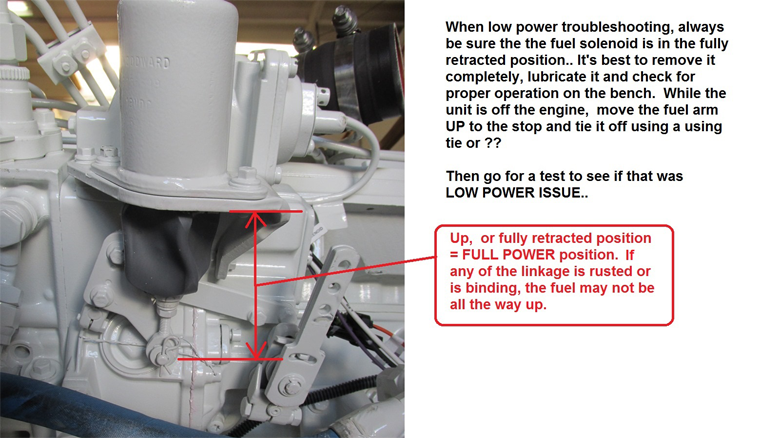
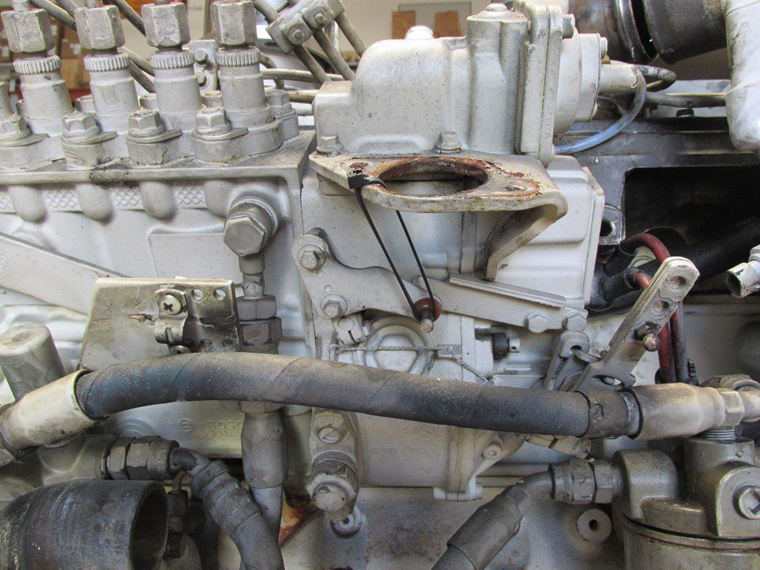
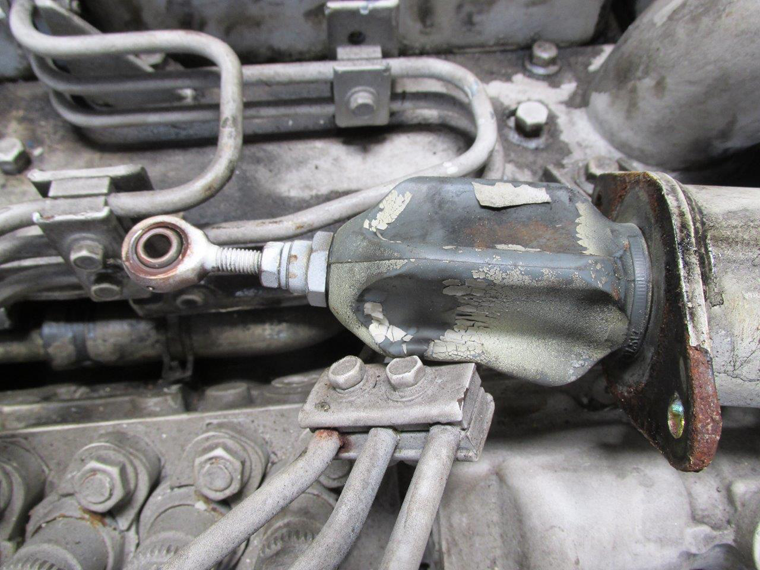
Some Easy Checks & Solutions to non getting plenty fuel (remember you lot have NO dark smoke):
- Checking the throttle or fuel solenoid command linkage (a more common event than you'd retrieve) itself is super easy to figure out. Adjust or check the linkage or command mechanism until the lever or shaft hits the stop and/or goes slightly into the spring override ( if the injection pump is of that style). This can all exist done with the engines turned off, at the dock.
- Clogged filters are easy to change and if you lot have a vacuum gauge installed you volition "see" the issue.
- Checking for a bad lift pump or return line cheque valve usually requires a pressure estimate to exist installed some place Subsequently the on-engine elevator pump.
- Until you practise all of the above, no sense in getting into more complex things like pick-up tube bug or aneroids as 99% of the time, you have already fixed the issue past doing all the in a higher place.
Basic Toll Effective STEPS IN LOW POWER TROUBLESHOOTING AND WHERE TO GO NEXT
NOW, enquire yourself…
Have you performed the nearly basic steps of "Low Power" troubleshooting listed in a higher place? That's NUMBER ONE and until you lot accept ID'd what your true symptoms are that friction match the higher up steps, yous do not need to go farther. Remember, it starts with a visual of the exhaust colour and then it's either YES or NO as to dark or black smoke.
NO Assistance & All the same AT A LOSS & WANT More than?
Let'south go back a tad to where you thought things were OK.. Practice you accept whatever good data from the by as to your operation "then"?.. This is the type of info you'd need to move forward in a "logical" way – (example follows of operational data for your vessel): Six months ago (or whenever) your vessel made 28-29K'due south at 3600 to 3650 RPM (at or close to the manufacturer'due south rated rpm) loaded as you lot typically apply the vessel. You cruised at 2800-3200 RPM and all was practiced-Yous were a happy camper. Your cruise speeds at those RPM'southward were equally follows:
2800 RPM = 18K's
3000 RPM = 20K's
3200 – 3300 RPM = 22-24K's (the vessel really started to "come alive"
Plus, when getting "over the hump" the boat was spunkier and seemed to do it with a minimum of struggling and a minimum of night smoke. Now, just all all of a sudden y'all exit the dock a month, 2, or three later for a typical trip and the engine seems to have lost its vigor and later on getting upwardly to your typical cruise RPM, you lot seem to exist traveling slower. You lot bank check things out & push the throttles up to the stops, simply you don't make the aforementioned RPM (or speed as earlier). You are now down to a WOT RPM of 3400 on one engine and 3350 on the other, & WOT speed is just 23-24 K's. Plus, to make matters worse, at your cruise RPM of 3200, the gunkhole is only making 19.5 – 20K's. What's wrong?? Playing with the trim tabs doesn't assist, and next you become for the fuel filters (very typical). Got to exist the problem?? No Help !! Anyway, y'all end the trip and over the next week or so you first asking around.
Does the above kinda fit where nosotros are at this point? If so, you demand to read what comes next (perchance a few times) and let it SINK IN. This is where agreement how engines, boats and propellers work in unison, and all together impact how fast the gunkhole travels. What follows is what I feel is the almost important principle of how boats, engines and propellers interact and the unmarried well-nigh misunderstood principle in the manufacture equally to vessel performance. And, that even applies to those who are supposed to understand engine and vessel functioning – Perhaps your "seasoned" mechanic or friendly surveyor qualifies???
The first matter to understand is that your vessel's propellers move the boat. All the engines are doing is turning them. Spin your props at "10" RPM and the vessel travels at "X" RPM or speed. It'south that elementary… Think about it and so think some more than, so the most bones of vessel operation has sunk into your head. At present we accept to go back again and look at what was happening half dozen months ago. Your engine fabricated 3600 RPM and your PROPS were rotating at 1800 RPM (you take a 2:1 gear ratio) making the vessel travel at 28-29K's, and at 3200 engine speed rpm (1600 prop RPM) your vessel fabricated 22-23K's. Correct? Again, remember information technology'due south the props that make the boat motion forward, the engine is but turning them. Now information technology's today and we have the aforementioned engine and we are at the 3200 RPM with the aforementioned props turning at the same 1600 RPM, simply the boat is but traveling at 19-20K's.. Hmmmmmm ??? Let's think long and hard about what is really going on. The props move the gunkhole !! The engines are just turning them at the same RPM. Simply the vessel is going slower at this Same RPM.
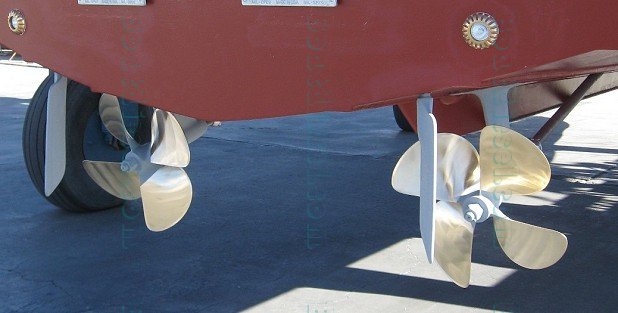
Call back AND Think SOME MORE!!
The Answer: Information technology'due south not a fuel supply issue (clogged filters, air leaks, etc, etc). Information technology's not injectors. It's not the turbo. In fact, to put it bluntly, IT'South NOT an engine related problem. It's a Boat ISSUE, or a problem that lies EXTERNAL to the engine. Recall a few paragraphs back I said to recollect that term?
If this still does make ane + one = 2 to yous, let's wait at information technology this way. If the props are still turning the same RPM but the vessel is going slower, information technology's no different than the following example – Your are cruising along at 22'ks at 3250 RPM with your 100 gallon bait tank full of water and allurement ' "loaded as you apply the boat" – You showtime dumping the 800 lbs of water and over the next 4-5 minutes y'all stare down at your vessel speed and now you are averaging 23-24 K's, notwithstanding your RPM is still at 3250. If you had a heave gauge you would accept seen your boost was higher earlier you dumped the h2o, however after losing the 800 lbs you are traveling faster and your boost is down a pound or so. If you had pyrometers, they may be a tad lower temp than earlier. How could that exist? Simple, the engine is working easier equally you have REMOVED something external to it—WEIGHT in this example. At present start filling the allurement tank and watch the contrary occur – Prop RPM the aforementioned, but the vessel slows down a knot or 2, and the engine is now working harder once again at that same RPM. The aforementioned thing applies to other things that touch on engine performance and vessel speed at equal RPM's as before – Bottom condition, prop status, windage, and of grade, whatever blazon or amount of ADDED weight. And in one case whatever of these EXTERNAL FORCES tin can become to a betoken to where you are by the maximum HP the engine can produce (at whatsoever RPM) , you are at present in an OVERLOADED condition caused by something EXTERNAL to the engine – This is a VESSEL related result, not an engine related consequence and since we are trying to sympathize these external forces that affect the engines performance, a propeller is the master force that is external to the engine.
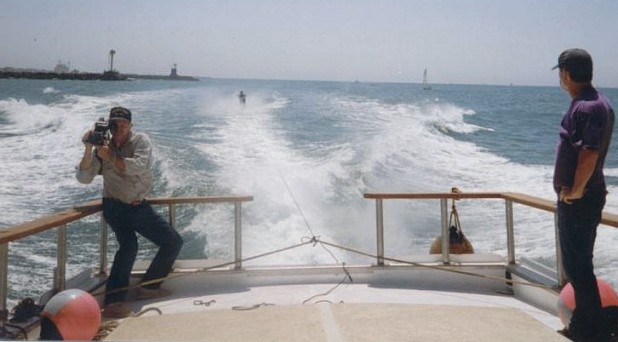 This h2o skier would be an example of a force EXTERNAL to the engine. Cutting the rope and the RPM stays the same only the vessel picks up 2+ Knots
If yous Can'T buy into this, then my respond is also very simple. Yous ARE IN Denial, and lack the most basic understanding of how a vessel's performance interacts with the engine'south capabilities. And if your mechanic is still picking away at your back pocket replacing injectors, rebuilding turbos, etc, and then you are in "double denial" and your mechanic, surveyor, friend or ?? is a buffoon as all you had to practice is understand what you lot simply read "propellers move boats – engines just turn them".
Lets go thru some of these nuts again and add some more to our database before we start replacing things similar filters or worse, parts like injectors:
- Strobed your engine and certified tachometer accurateness?. This should always be done and done when y'all kickoff commencement using your gunkhole, especially if operation was a key part of the reason yous bought the boat. In so many words, an accurate tachometer reading, paired with the manufacturer'due south power curve information and ratings, is the starting indicate for ALL engine & vessel functioning parameters.
- Confirmed that the fuel stop or solenoid lever, and throttle linkage are 100% into their corresponding stops when at WOT? This basic mechanical bank check is overlooked quite often with $$ being spent unnecessarily more than times than you really want to know virtually.
- And, for the guys who desire the very almost they tin can go from their engine without going over the edge – Have yous considered installing a boost gage (power) & pyrometer (prophylactic cylinder temps) ? – this is the ONLY way to gauge horsepower & the engines condom operation output outside of having accurate instantaneous fuel consumption gauges. These gauges can exist super of import tools to allow you to have baseline engine performance information for now and for afterward when you start having issues. If maximum performance is part of your agenda, consider installing these gauges and learning what they are telling you as information technology'due south money & time well spent.
- Installed BOTH fuel vacuum AND fuel force per unit area gauges, and recorded results at speeds in gear and out of gear above 1600-2000 RPM when you think you have a fuel supply issue? Near mechanical engines allow you lot to do this at the dock in neutral. Although a vacuum gauge is much easier to install, it does not always tell the whole story. If you can't brand the needed fuel pressure level after the engines lift pump, information technology won't thing if the vacuum gauge is giving you a Green light (and many times they do).
- Installed a articulate line with a loop in it just earlier the engine in example you think you have an air leak??
- Measured frazzle back pressure? (This is a depression number typically measured in inches of water column or MM of Hg (ordinarily in the 1/two PSI – 2 PSI range if you recall "PSI"). Turbos can slow downwards with age and /or clothing (backlog pressure over fourth dimension), and from saltwater getting to them because of a poorly designed wet exhaust system. All of these can cause dark or black smoke affecting the engines overall performance (lack of air), and all may happen over a period of weeks to months. If you had installed a pyro, nearly times you'll see this coming.
- Peeked at return flow to insure it by and large matches the spec sail as to total fuel flow??. Most mechanical engines in neutral and at college RPM'due south will testify close to 90% of maximum fuel period going into the render line.
- Checked injection pump timing?. Not a likely issue unless someone has R&R-ed the pump, but something that can exist a prudent thing to do subsequently all of the above have been performed.
NOW, to move on, a trial run or mini-seatrial is of import to "meet" how the vessel runs AFTER these simple steps are gone through so many times the vessel operator does not actually "run into" what is really happening but simply knows the ability is low in comparison to some before time in the vessel performance.
When an engine has low ability complaint issues or symptoms, and these steps are by-passed (expensive mechanical parts are changed/rebuilt before these most basic operating parameters are checked) it's far from the smart way or cost effective way to go virtually finding the problem. The order in which I listed them would exist close to how I would get about finding the issue, unless I saw something on a sea trial that appeared likely to be the problem. This is where a truly experienced and passionate mechanic can actually make a departure, and IMO, you will rarely discover one of these that does not work for himself. In so many words, a "manufactory certified" mechanic doesn't agree much water in my volume if he is nevertheless working for a major engine distributor every bit all they seem to call up is to be sure they become the needed "billable hours" when they render to the shop. Solving the "reason" to the event is commonly not part of their programme. But replacing parts is always part, regardless of "WHY".
Dorsum to our "mini-body of water trial": The two near of import operational parameters that I would look at (a visual look based upon 25+ years of looking at thousand's of engines) on the first run:
- How much crankcase by-pass you take at 1000 RPM in neutral vs at 2000 RPM+ in gear so I could get a experience for the general condition of the engine, AND….
- Confirming the color of the frazzle fume during whatever type of "performance lagging" condition…….
Hopefully all of the above will help you diagnose the issue quicker and cheaper. REMEMBER, that in just near every example if you take any night smoke, it's not a fuel restriction result or under fueled condition.
Equally to injector issues which always seems to come up with inexperienced mechanics or ones looking to brand a quick & easy buck, that'due south just about never the event unless y'all know water went thru the system. And and so, information technology's just about always, tons of WHITE smoke.
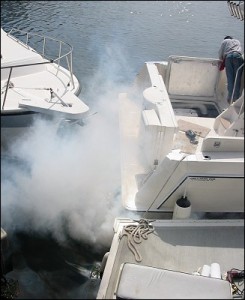 If nosotros were to talk nigh a specific and very popular engine, the Cummins 370 Diamond, IMO, AN Authentic 3100 RPM loaded for carry is the minimum you should meet, merely we prefer 3125-3150. And, BTW, this aforementioned 100++ RPM over-rated RPM is a must for whatever engine in this class (50-threescore+++ hp per liter). Remember, as the HP per liter climbs, so being able to reach over the minimum rated RPM becomes even more important IF you lot want decent engine life and desire maximum operation out of your engine.
If you have a later electronic engine with accurate fuel and % of load data, then instead of using my rule of 100++ over rated, you accept to compare the full fuel consumption at the engines RATED RPM (print out the manufacturer's performance curve) vs what y'all take on your digital gauges. If your HP per liter at rated RPM and load is above lx HP, IMO you never want to be propped to have the engine fire more than 95% of its max fuel burn at its exact rated RPM. Load % should too be at 95% or less at rated RPM but may show 100% at WOT as your engine volition exceed that rated RPM by 30-threescore or so depending on the electronics and programming of the engine. A bear on more tricky to understand in some means, but because of "digital gauges" with a little understanding and homework, you can prop your vessel for maximum performance while also beingness sure you are non going over the edge on these very high performance marine diesels.
Source: https://www.sbmar.com/featured-article/understanding-low-power-troubleshooting/
0 Response to "Why Is the Power Off on Santiago Peak Again"
Publicar un comentario